Artificial intelligence has become a part of everyday work for many developers and businesses. Whether it's generating code, answering questions, summarizing documents, or drafting emails, AI assistants have significantly improved productivity. As these tools have become more common, another term has started appearing more frequently in conversations: AI agents.
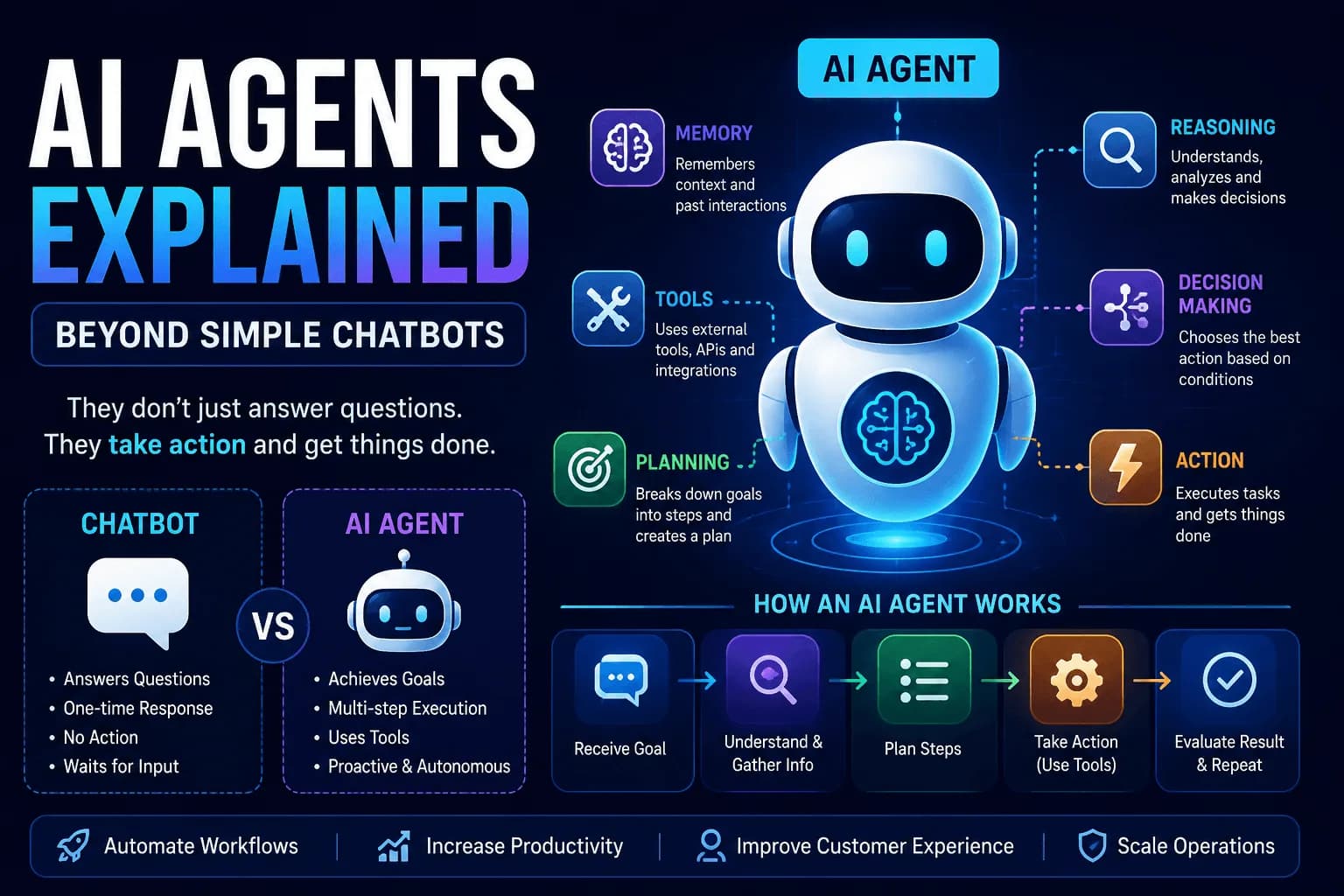
At first glance, AI agents may seem like another name for chatbots or AI assistants. After all, both can understand natural language and generate intelligent responses. However, the difference goes far beyond conversation. While a chatbot is primarily designed to answer questions, an AI agent is designed to achieve a goal by making decisions, using external tools, and executing multiple tasks with minimal human intervention.
Understanding this distinction is important because many businesses believe adding a chatbot means they've adopted AI agents. In reality, the two solve very different problems.
In this guide, we'll explore what AI agents are, how they differ from traditional chatbots, the technologies that power them, their real-world applications, and why they are becoming one of the most significant developments in modern software.
What Is an AI Agent?
An AI agent is an intelligent software system designed to accomplish a specific objective rather than simply respond to prompts.
Unlike a traditional chatbot that waits for user input and returns an answer, an AI agent can observe information, analyze the situation, make decisions, use external tools, and complete multiple actions to reach a desired outcome.
Think of it this way.
A chatbot answers questions.
An AI agent performs work.
For example, if a customer asks:
"I'd like to change my delivery address."
A chatbot may explain how the customer can update their address.
An AI agent could identify the customer, verify the order, check whether the shipment has already been dispatched, update the delivery address if possible, notify the shipping provider, and finally send a confirmation email.
The goal isn't simply generating a response—it's completing the task.
This ability to combine reasoning with action is what separates AI agents from conversational AI.
AI Chatbots vs AI Agents
Although both technologies are powered by large language models, they operate very differently.
A chatbot is primarily conversation-driven. It receives a prompt, processes it, generates a response, and then waits for the next instruction. Every interaction is largely independent unless conversation history is maintained.
An AI agent works differently.
Instead of focusing solely on generating responses, it focuses on achieving an objective. It can determine which information it needs, access external tools, retrieve data, execute actions, evaluate the results, and continue working until the task is completed.
For example, asking a chatbot to summarize yesterday's sales report will usually produce a summary if the report is provided.
An AI agent could retrieve the report automatically, analyze the sales figures, identify unusual trends, generate the summary, email it to management, and schedule another report for the following morning—all without requiring separate prompts for each step.
This shift from conversation to execution is what makes AI agents so powerful.
The Building Blocks of an AI Agent
Although AI agents may appear highly intelligent, they are built by combining several different components, each responsible for a specific role.
Understanding these components helps explain why AI agents are capable of much more than answering questions.
Large Language Model
At the core of most AI agents is a large language model.
This acts as the reasoning engine.
It interprets instructions, understands natural language, evaluates possible actions, and determines the next logical step based on the available information.
Without the language model, the agent would be unable to understand goals or make informed decisions.
Memory
Memory allows an AI agent to retain information beyond a single interaction.
Short-term memory helps the agent remember the current conversation or workflow, while long-term memory allows it to retain useful information such as customer preferences, previous interactions, or frequently used processes.
This enables the agent to make more informed decisions over time instead of treating every request as completely new.
Tools
One of the biggest differences between chatbots and AI agents is the ability to use external tools.
These tools might include:
Rather than relying solely on its training data, an AI agent can retrieve live information, update records, create documents, or trigger workflows by interacting with these systems.
Tools transform AI from an information provider into an active participant in business processes.
Planning
Complex tasks often require multiple steps.
Instead of responding immediately, an AI agent can develop a plan before taking action.
For example, if asked to prepare a weekly sales report, the agent might first retrieve sales data, then calculate key metrics, identify trends, generate visualizations, prepare a summary, and finally distribute the report to stakeholders.
Breaking large objectives into smaller tasks allows the agent to solve problems more effectively.
Decision Making
AI agents also evaluate conditions throughout a workflow.
For example, if payment has already been received, the order may move directly to fulfillment.
If payment is missing, the agent may instead send a reminder email.
This ability to make conditional decisions allows AI agents to adapt to different situations rather than following a single predefined sequence.
A Real-World Business Example
Imagine a customer sends the following email:
"Hi, I'd like to reschedule my appointment to next Tuesday."
A traditional chatbot would likely respond by explaining how appointments can be changed or provide a link to the booking system.
An AI agent approaches the situation differently.
First, it identifies the customer from the email address.
Next, it retrieves the existing appointment details.
It then checks calendar availability for the requested day.
If multiple time slots are available, it selects the most appropriate one based on predefined business rules.
The appointment is updated automatically, confirmation emails are sent to both the customer and staff, and the calendar is synchronized.
From the customer's perspective, the entire process feels seamless.
Behind the scenes, however, the AI agent has coordinated multiple systems and completed several independent tasks without requiring human intervention.
AI Agents in Software Development
AI agents are also changing the way developers build software.
Today's AI coding assistants can already generate functions, explain code, and suggest improvements. AI agents extend these capabilities even further.
Instead of generating isolated code snippets, an AI agent can analyze project requirements, inspect an existing codebase, search documentation, identify relevant files, suggest architectural improvements, generate implementation plans, write code, execute tests, identify failures, and recommend fixes.
Some development teams are already experimenting with agents that monitor repositories, review pull requests, update project documentation, and automate repetitive engineering tasks.
While developers remain responsible for architectural decisions and quality assurance, AI agents are increasingly becoming valuable collaborators throughout the development lifecycle.
Common Misconceptions About AI Agents
As AI agents become more popular, several misconceptions have emerged.
One common belief is that every chatbot is automatically an AI agent.
In reality, most chatbots simply generate responses without performing actions or interacting with external systems.
Another misconception is that AI agents replace developers or employees entirely.
While agents can automate repetitive tasks, they still require human oversight, clearly defined objectives, and well-designed workflows.
Some people also assume AI agents possess unlimited knowledge.
In practice, their effectiveness depends on the quality of the information, tools, permissions, and context they receive.
An AI agent is only as capable as the systems it can access.
Current Limitations
Despite their capabilities, AI agents are not without limitations.
They can misunderstand objectives if instructions are unclear.
They may produce inaccurate information when external data is unavailable.
Poorly designed workflows can lead to unnecessary actions or unexpected results.
Security also becomes increasingly important because agents often interact with business systems, customer information, payment services, and confidential data.
For these reasons, most organizations still keep humans involved when approving sensitive actions or reviewing important decisions.
Human oversight remains an essential part of responsible AI implementation.
Best Practices for Building AI Agents
Organizations looking to implement AI agents should begin with a single, clearly defined workflow rather than attempting to automate everything at once.
Agents perform best when objectives are specific and measurable.
Providing access only to the tools required for a particular task reduces security risks and simplifies maintenance.
It's equally important to monitor agent activity through logging and auditing so that every action can be reviewed if necessary.
Finally, treat AI agents as part of your software architecture rather than standalone tools. Their success depends not only on the language model but also on APIs, documentation, data quality, permissions, and thoughtful workflow design.
Final Thoughts
AI agents represent an important evolution in how artificial intelligence is applied within software and business operations. While chatbots focus on conversation, AI agents focus on accomplishing goals by combining reasoning, planning, memory, external tools, and decision-making into a single workflow.
As organizations continue adopting AI, the greatest opportunities are likely to come from automating meaningful business processes rather than simply generating faster responses. Whether it's managing customer support, coordinating internal operations, assisting developers, or integrating multiple business systems, AI agents have the potential to transform how work is completed.
Understanding how they differ from traditional chatbots is the first step toward designing solutions that deliver real value. Rather than viewing AI agents as replacements for human expertise, they should be seen as intelligent collaborators capable of handling repetitive, structured tasks while allowing people to focus on strategy, creativity, and complex decision-making.