For the past couple of years, "prompt engineering" has become one of the most talked-about skills in the AI industry. Developers, marketers, writers, and businesses have spent countless hours learning how to write better prompts in order to get better responses from AI tools.
While prompting is still important, the way professionals use AI is beginning to change.
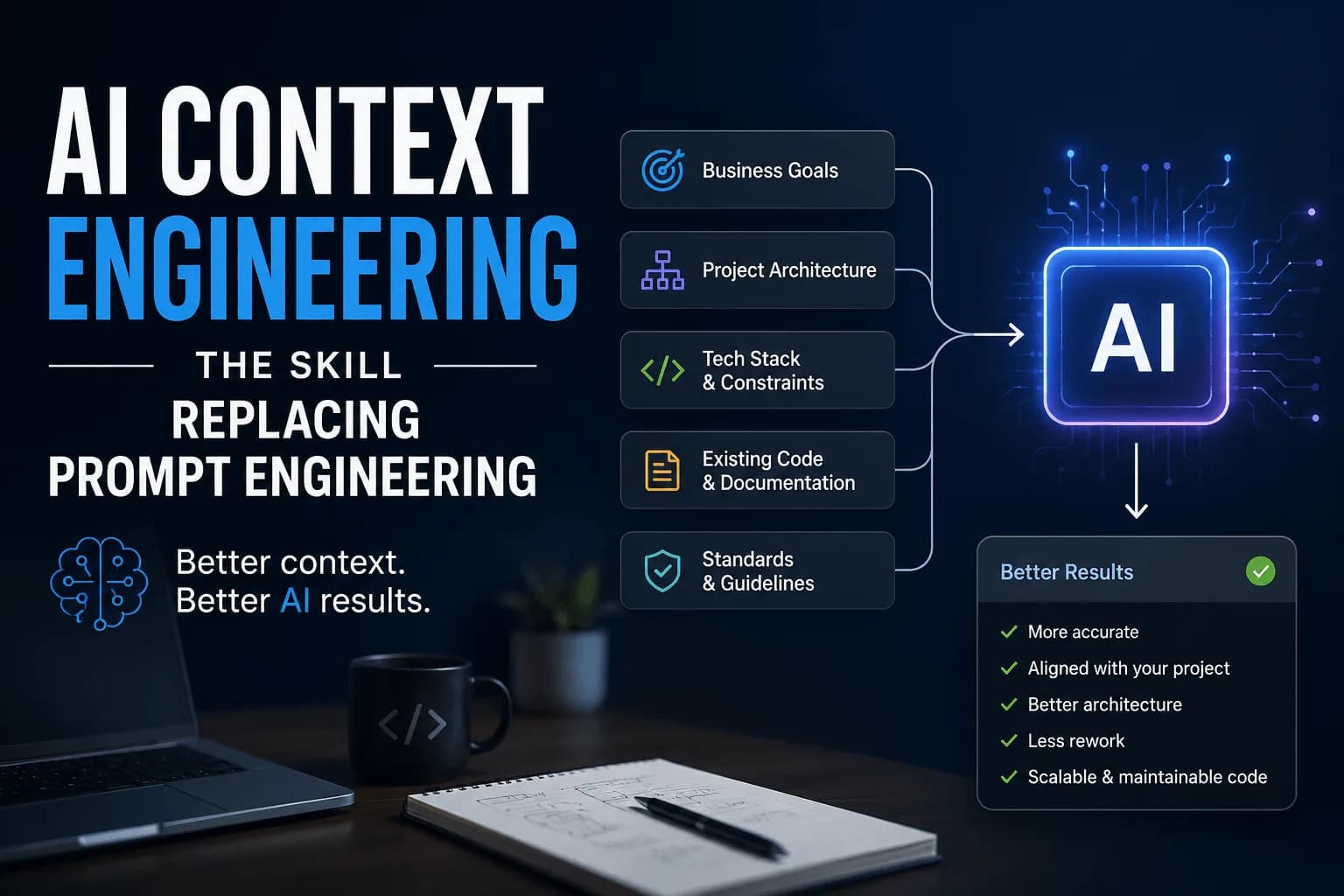
As AI models become more capable, success depends less on crafting the perfect prompt and more on providing meaningful context. Instead of asking AI to generate code, write content, or solve problems with minimal information, professionals are now sharing project architecture, business goals, technical constraints, existing documentation, and expected outcomes before asking for a solution.
This shift is commonly referred to as context engineering, and it's quickly becoming one of the most valuable skills for anyone using AI in professional environments.
Whether you're building a WordPress plugin, designing a web application, creating marketing content, or planning a business workflow, the quality of AI-generated results is increasingly determined by the quality of the context you provide.
What Is Context Engineering?
Context engineering is the process of providing AI with all the relevant information it needs to understand a project before asking it to perform a task.
Rather than treating AI like a search engine or code generator, context engineering treats it as a collaborator that needs to understand the bigger picture.
Instead of simply asking:
"Build a WooCommerce plugin."
You might explain:
The business requirements
Existing project architecture
Folder structure
Coding standards
WordPress version
WooCommerce version
Performance requirements
Expected user experience
Future scalability requirements
Although the actual request may remain the same, the quality of the response changes dramatically because the AI has enough information to make informed decisions instead of making assumptions.
The more accurately AI understands the project, the more relevant and maintainable its output becomes.
Prompt Engineering vs Context Engineering
Prompt engineering focuses on asking the right question.
For example, developers might ask AI to write a function, explain an error, generate documentation, or create a component. While this approach often produces useful results, the AI has very little understanding of the project itself.
As a result, its answers are usually generic.
Context engineering approaches the problem differently.
Instead of immediately asking for implementation, developers first provide information about the application, business objectives, existing architecture, coding conventions, dependencies, security requirements, and technical constraints.
Rather than guessing how a project is structured, AI receives enough context to understand why a solution should be built in a particular way.
In many cases, this leads to better architectural decisions before implementation even begins.
Why Context Produces Better Results
Artificial intelligence doesn't truly understand your business, your users, or your software architecture.
It only understands the information available during the conversation.
When context is missing, AI fills those gaps with assumptions.
Sometimes those assumptions are correct.
Often, they are not.
For example, asking AI to build a login system without explaining authentication requirements, user roles, security policies, or the existing application architecture will usually produce a generic implementation.
Providing that information beforehand allows AI to generate a solution that's much closer to what the project actually requires.
Context reduces ambiguity.
Instead of forcing AI to guess, it enables AI to reason within the boundaries of your project.
A Practical Example
Imagine you're developing a custom WordPress plugin.
A simple prompt might look like this:
Build a WordPress plugin that stores customer enquiries.
The response will probably work.
However, it won't know:
How your project is organized
Whether you're following WordPress Coding Standards
Whether the plugin needs to integrate with WooCommerce
Whether you're using custom database tables
Which PHP version you're targeting
Whether scalability is important
How the data will be used later
Now consider providing additional context before asking for the implementation.
You explain that the project uses a plugin-first architecture, follows WordPress Coding Standards, supports PHP 8.3, integrates with WooCommerce, stores data in custom tables, and should remain maintainable as new features are added.
The implementation AI produces will likely be very different.
Instead of simply generating code that works, it begins producing code that fits the project.
That's the real value of context engineering.
What Good Context Looks Like
Providing useful context isn't about writing longer prompts.
It's about providing the right information.
Some of the most valuable pieces of context include:
Business objectives
User requirements
Existing architecture
Technology stack
Folder structure
Database design
Coding standards
Performance expectations
Security requirements
Expected output
Not every project requires all of this information, but the more relevant context you provide, the fewer assumptions AI needs to make.
Think of it as onboarding a new developer to your project.
The more they understand your system, the better decisions they can make.
AI works in much the same way.
My Experience with Context Engineering
When I first started using AI for development, I approached it like many developers did.
I asked it to generate code.
Sometimes the results were excellent.
Other times, I found myself rewriting large portions of the implementation because the solution didn't quite fit the project.
Over time, I realized the issue wasn't the quality of the AI.
It was the quality of the information I was providing.
Instead of jumping directly into implementation, I started explaining the project first.
I'd describe the architecture, the folder structure, the business requirements, coding standards, and long-term goals before asking AI to generate code.
The difference was immediately noticeable.
The conversations became less about fixing generated code and more about discussing architecture, evaluating trade-offs, and refining the overall solution before implementation even began.
That shift has probably had a bigger impact on my workflow than any individual AI feature.
Context Engineering in Modern Web Development
This approach isn't limited to WordPress.
Whether you're building applications with Next.js, Laravel, React, Node.js, or another framework, context engineering improves the quality of AI-assisted development.
For example, when working on a Next.js application, sharing the project structure, routing approach, state management strategy, and deployment environment allows AI to provide recommendations that align with the existing application instead of suggesting unrelated patterns.
The same principle applies to API integrations, mobile applications, and cloud infrastructure.
Good context leads to better technical decisions regardless of the technology stack.
Why Businesses Should Care
Context engineering isn't only valuable for developers.
Businesses also benefit from it.
When developers spend time defining business objectives, technical constraints, user journeys, and long-term requirements before implementation begins, the software they build is generally easier to maintain, more scalable, and less expensive to extend in the future.
AI can accelerate development, but only if it's working toward the right objective.
Providing proper context ensures that technical decisions remain aligned with business goals instead of simply optimizing for speed.
For organizations adopting AI into their workflows, context engineering may ultimately become more valuable than prompt engineering itself.
Best Practices for Context Engineering
Successful context engineering starts with understanding the problem before requesting a solution.
Begin by clearly explaining the business objective rather than immediately describing the feature you want to build.
Share information about your existing architecture, technology stack, coding standards, dependencies, and technical constraints. If the project already contains relevant code or documentation, include that as well.
Rather than expecting AI to deliver the perfect solution in a single response, treat the interaction as an iterative conversation. Review the output, provide additional context where necessary, and continue refining the solution.
The goal isn't to create the longest possible prompt. It's to provide enough information for AI to make informed decisions.
Common Mistakes
One of the most common mistakes developers make is assuming AI understands the project simply because it understands the programming language.
Knowing PHP isn't the same as understanding your WordPress plugin architecture.
Another common mistake is focusing entirely on implementation while ignoring business requirements. AI can generate thousands of lines of code, but without understanding the underlying objective, even technically correct solutions may fail to solve the real problem.
Finally, many users expect AI to produce the perfect answer in a single interaction.
In reality, the best results often come from iterative conversations where additional context is introduced as the solution evolves.
Final Thoughts
As AI continues to evolve, the ability to write clever prompts is becoming less important than the ability to communicate context effectively.
Developers who understand their architecture, business requirements, and technical constraints will consistently achieve better results than those relying solely on prompt engineering techniques.
In many ways, context engineering reflects how experienced software teams have always worked. Good developers don't begin with implementation—they begin by understanding the problem, defining requirements, and designing a solution that can evolve over time.
AI hasn't changed that principle. If anything, it has reinforced it. The future of AI-assisted development isn't about asking better questions. It's about creating better context. That may become one of the most valuable technical skills of the next decade.