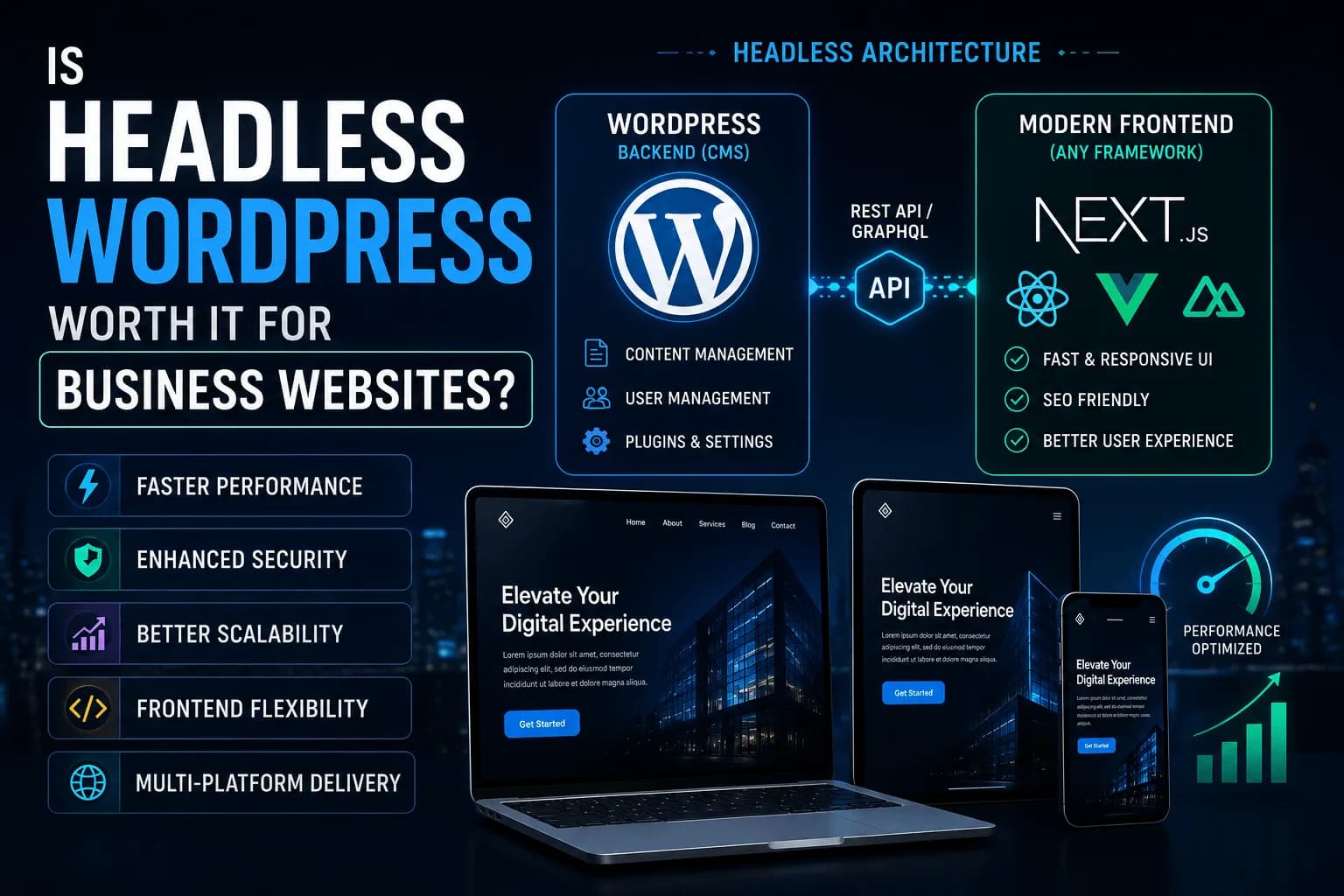
WordPress powers a significant portion of the web, and for many businesses, it remains one of the most reliable content management systems available. However, as performance expectations, user experience standards, and modern web technologies continue to evolve, many organizations are exploring a newer architecture known as Headless WordPress.
If you've been researching modern website development, you've probably encountered claims that Headless WordPress is faster, more secure, and more scalable than traditional WordPress. While there is some truth to these claims, the reality is more nuanced.
The important question isn't whether Headless WordPress is better. The real question is whether it makes sense for your specific business requirements.
What Is Headless WordPress?
In a traditional WordPress setup, the backend and frontend are tightly connected.
WordPress handles:
Content management
Database operations
Theme rendering
Frontend presentation
In a Headless WordPress architecture, WordPress continues to manage content, but the frontend is built using modern technologies such as:
Next.js
React
Vue
Nuxt
Gatsby
Instead of rendering pages through WordPress themes, content is delivered through APIs and displayed by a separate frontend application.
This separation is what gives Headless WordPress its name.
Understanding the Headless WordPress Benefits
One reason businesses are considering headless wordpress benefits is the ability to improve website performance and flexibility.
Let's examine the major advantages.
Faster Website Performance
Performance is often the biggest motivation behind moving to a headless architecture.
Traditional WordPress websites generate pages dynamically, which requires:
PHP processing
Database queries
Theme rendering
Plugin execution
With a modern frontend framework such as Next.js, much of this work can be optimized through:
The result is often a significantly faster user experience.
Better Core Web Vitals
Google continues to emphasize user experience through Core Web Vitals.
Headless architectures often perform better in:
Largest Contentful Paint (LCP)
Interaction to Next Paint (INP)
Cumulative Layout Shift (CLS)
This can positively influence both user satisfaction and search visibility.
Improved Scalability
As businesses grow, traffic demands increase.
Traditional WordPress websites may require extensive optimization when traffic spikes occur.
Headless architectures typically scale more efficiently because:
Frontend resources can be distributed globally
CDN usage becomes more effective
Static assets reduce server workload
Content delivery becomes faster
For high-traffic businesses, scalability can become a major advantage.
Enhanced Security
WordPress itself is generally secure when properly maintained. However, because traditional WordPress exposes its frontend directly, there are more potential attack surfaces.
A headless setup can reduce certain risks by separating:
This doesn't eliminate security concerns, but it often creates a stronger architecture.
Greater Frontend Flexibility
Traditional themes have limitations.
With Headless WordPress, developers can build highly customized user experiences using modern frontend frameworks.
Benefits include:
For businesses prioritizing user experience, this flexibility can be valuable.
Better Multi-Platform Content Distribution
One overlooked advantage of headless wordpress benefits is content reusability.
The same content can be delivered to:
Websites
Mobile applications
Digital kiosks
Smart devices
Internal portals
WordPress becomes a centralized content hub rather than simply a website backend.
When Headless WordPress May Not Be Worth It
Despite its advantages, Headless WordPress isn't the right solution for every business.
In fact, many websites perform perfectly well using traditional WordPress.
You may not need Headless WordPress if:
Your website is relatively simple
You primarily publish blog content
Your traffic levels are moderate
You rely heavily on page builders
Your budget is limited
For many small businesses, traditional WordPress remains an excellent choice.
Higher Development Costs
One of the biggest drawbacks is cost.
A traditional WordPress site may be built using themes and plugins.
A headless solution often requires:
The initial investment is usually higher.
Increased Complexity
Headless architectures introduce more moving parts.
Instead of maintaining one system, you're maintaining:
WordPress backend
Frontend application
API layer
Deployment workflows
While powerful, this complexity requires technical expertise.
Real-World Business Use Cases
Headless WordPress is particularly useful for:
Enterprise Websites
Large organizations often need:
Scalability
Performance
Multi-channel publishing
Headless architectures help support these requirements.
SaaS Companies
Software companies frequently prioritize:
Headless WordPress fits naturally into this environment.
High-Traffic Marketing Websites
Businesses investing heavily in SEO and paid traffic often benefit from improved performance and scalability.
Global Brands
Organizations serving international audiences can leverage CDNs and distributed infrastructure more effectively.
Traditional WordPress vs Headless WordPress
Traditional WordPress remains an excellent solution when:
Headless WordPress becomes attractive when:
The best choice depends on business goals rather than industry trends.
Final Thoughts
The discussion around headless wordpress benefits often becomes overly simplified. Headless WordPress is not automatically better than traditional WordPress.
However, for businesses focused on performance, scalability, modern user experiences, and future growth, it can provide significant advantages.
My general recommendation is simple: don't adopt Headless WordPress because it's popular. Adopt it because your business requirements justify the additional complexity and investment.
When implemented correctly, Headless WordPress can deliver faster websites, stronger user experiences, and a more flexible foundation for long-term growth. But for many businesses, a well-optimized traditional WordPress website remains the smartest and most cost-effective solution.